When Richard Donner‘s Superman opened in December 1978, I was a newborn. My parents tell me that I stayed awake through the entire film, and I have been a Superman fan for as long as I have been anything at all. The film promised audiences that they would believe a man could fly, and I have believed it ever since.


That is why this morning’s news landed so hard. Skydance, which absorbed Warner Bros. Discovery in October, announced that James Gunn and Peter Safran will no longer lead DC Studios, and that former Marvel executive Jeremy Latcham will take their place. The official language describes the pair as stepping down to return to creative work, and Gunn will still direct Man of Tomorrow next summer. His own statement, however, calls his four years at the studio “trying,” and I find it difficult to read the announcement as anything other than a decision made for them.
There have been many fine portrayals of the Man of Steel, but Gunn’s Superman, with David Corenswet in the cape, is my favorite since Christopher Reeve. Gunn recaptured something of the powerful innocence that Donner and Reeve gave the character, a goodness that draws its strength from never curdling into cynicism. Corenswet’s Superman faces a public that Lex Luthor has turned against him, and he answers that hatred without borrowing any of Batman’s darkness. He stays kind because kindness is who he is, whether or not anyone rewards him for it.
Reeve’s Superman was often dismissed as a Boy Scout, too earnest for a cynical age. That earnestness is what makes the helicopter rescue work, when Margot Kidder‘s Lois, caught in midair, asks, “You’ve got me? Who’s got you?” The beauty of Gunn’s writing is that he never apologizes for the Boy Scout. Where other filmmakers have treated Superman’s decency as a problem to be solved with brooding or moral compromise, Gunn treats it as the whole point of the character.
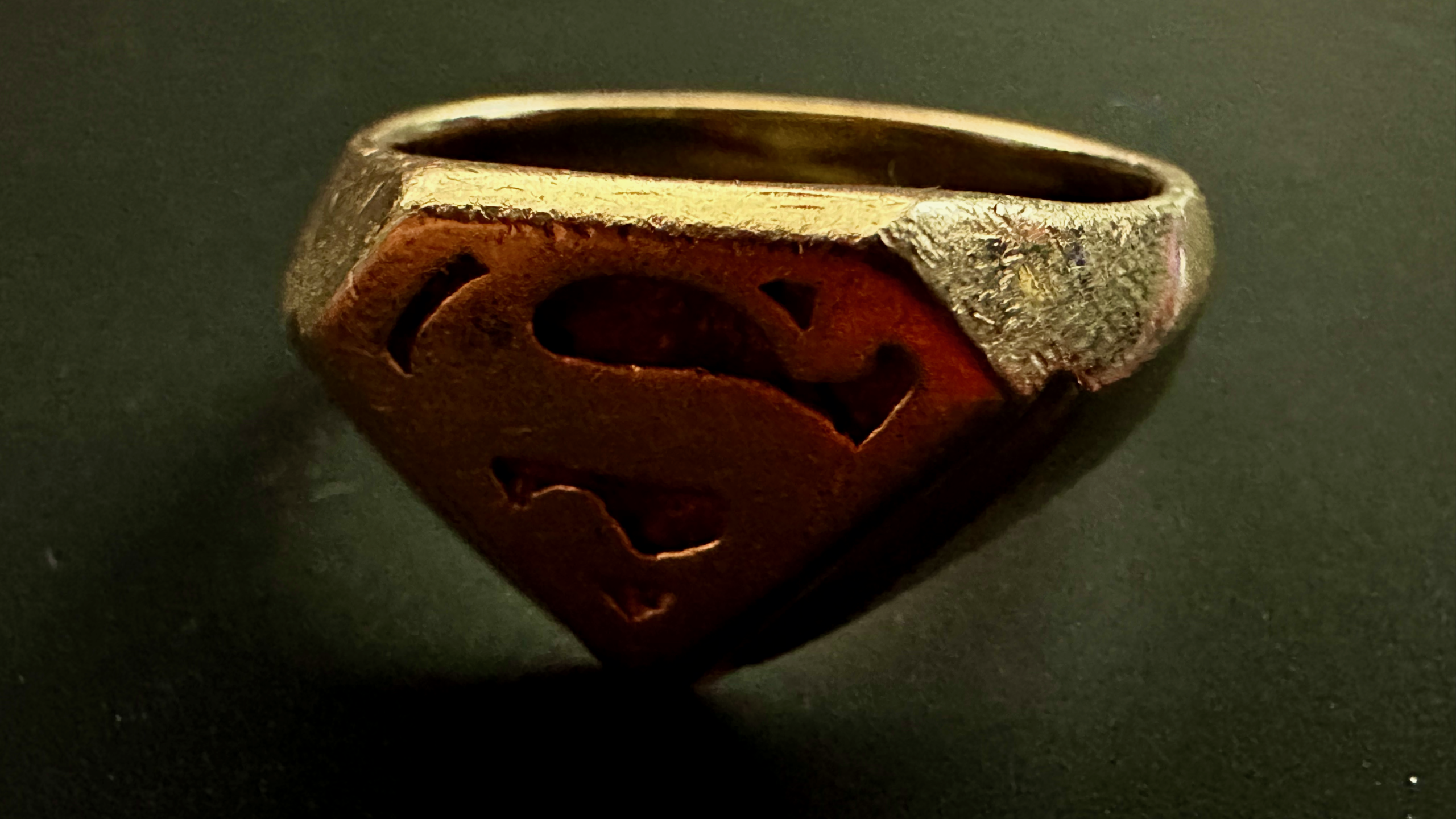
I wear that reminder every day. When Jenn and I were married, she gave me a custom silver Superman ring, which she had remade in gold for our fifteenth anniversary. It is a small, constant reminder of a standard that Superman meets far more reliably than the rest of us do: doing the right thing no matter what it costs.
In this summer’s Supergirl, Kara Zor-El sets herself apart from her cousin by explaining that he sees the good in everyone, while she sees the truth. She means it as a criticism, and given what she has survived, the film lets her earn it. I would argue, though, that seeing the good in people is its own kind of truth, and a harder one to hold onto.
Gunn’s boldest choice was to ask where that goodness comes from. Donner’s Jor-El, played by Marlon Brando, sends his only son to Earth because of humanity’s “capacity for good.” In Gunn’s film, the corrupted half of Jor-El and Lara’s message is finally decoded, and it reveals that the parents Kal-El has drawn comfort from all his life sent him to Earth to rule it. Whatever goodness Clark has, he learned in Kansas. Martha and Jonathan Kent, played by Neva Howell and Pruitt Taylor Vince, are real farmers, plainspoken and unglamorous, and when their son comes home broken, Jonathan tells him that his choices, not his origins, make him who he is. I found it quietly brilliant that Gunn located Superman’s decency in rural, Middle American parents without making them the bigots that so much of our culture now assumes farm country must produce. Lois’s question has an answer in this film; the Kents have got him, and they always did.
The same decency shows up in a moment small enough that many viewers missed it. One of the robots in the Fortress of Solitude, known only by the number Four, asks to be called Gary, and Superman simply calls him Gary, without hesitation and without commentary. I can think of no cleaner illustration of how easy it is to support our trans and nonbinary siblings. When someone tells you who they are and you use the name they have given you, the moment passes almost unnoticed, yet the person in front of you leaves knowing that they are safe with you.
Jerry Siegel and Joe Shuster, two Jewish sons of immigrants in Cleveland, sent their hero to Earth in a small vessel, much as the infant Moses was set adrift on the Nile, and readers have understood Superman as a messianic figure ever since. What such a figure offers lies in the example rather than the rescue. Superman has always stood up for the underserved, the marginalized, and the downtrodden, and in doing so he shows the rest of us how to treat our brothers and sisters. That example has followed me into primary care, where so many of the patients who walk through the door are the people he was created to defend.
It has followed my family, too. My late mother, an extraordinary seamstress, made my Superman costumes by hand when I was a boy, and my father shared his love of the 1978 film with me long before I understood why it moved him. Those who knew me in graduate school will remember my son Porter wearing his Superman pajamas, cape included, nearly everywhere for years. He is pre-med now, and I like to think a little of that cape went with him.
Gunn gave my family a Superman who matched the one we had already been carrying through three generations. I am grateful that he will still make Man of Tomorrow, and I hope Jeremy Latcham understands what he has inherited. I would rather not believe that politics played any part in today’s decision. In the present climate, however, it is not hard to imagine someone finding a Superman inconvenient when he answers hatred with kindness and calls Gary by his name.
Whatever happens next at DC, I will keep wearing the ring.
This post was written by the author. Claude (Anthropic) assisted with drafting and editorial refinement. All interpretations and opinions reflect the author’s own judgment.
Bluesky Discussion
View on BlueskyNo replies yet. Be the first to comment on Bluesky!
Discover more from Allred Consulting
Subscribe to get the latest posts sent to your email.